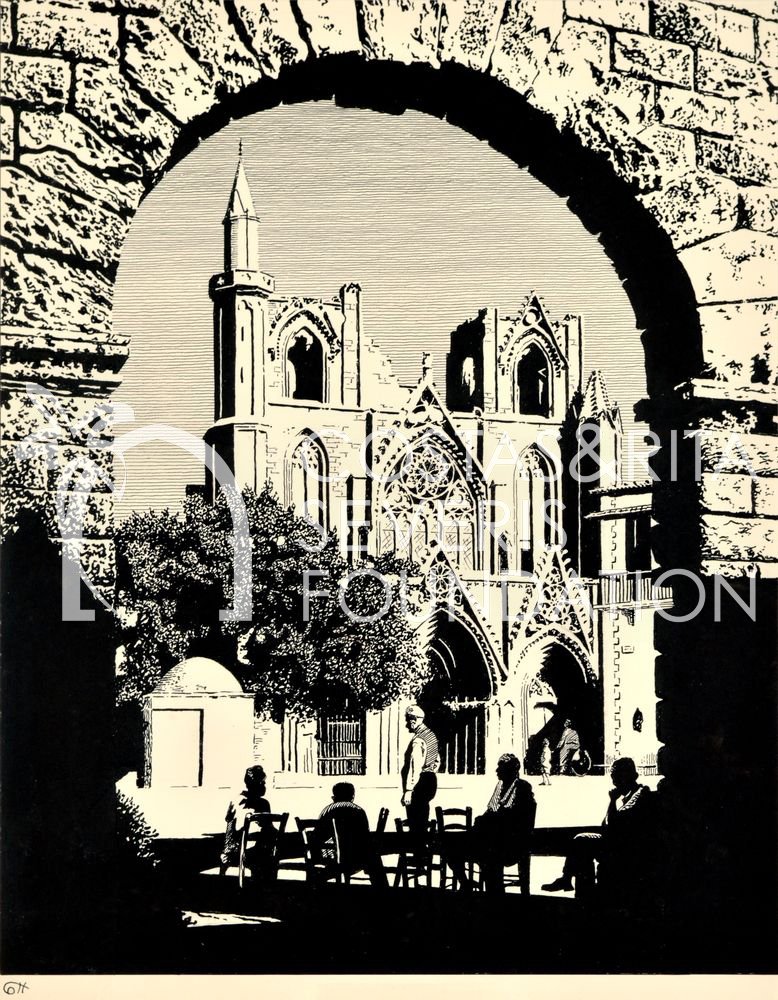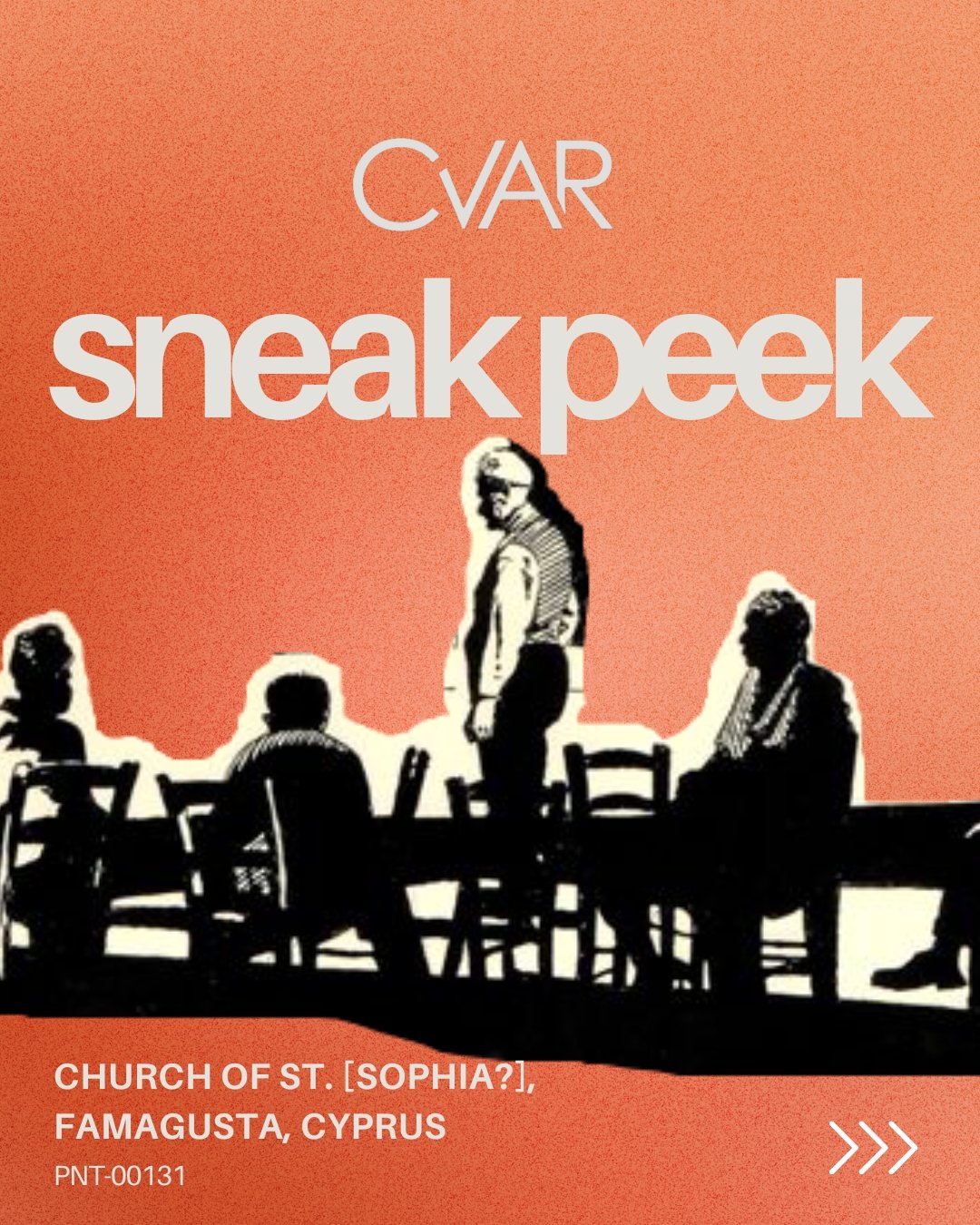
The pen and ink drawing of the Latin Cathedral of St Nicholas, misleadingly titled ‘St Sophia, Famagusta’, exhibits Cott’s techniques. Dark shadows in the foreground contrast with a bright background in a differential blending. Figures sit at a coffee shop in front of the cathedral and are seen through one of the arches of Palazzo Providadore (the Venetian Palace) opposite the Cathedral. The cumbez tree appears as a dark mass on the left and in front of the Cathedral. The single minaret of Lala Mustafa Mosque (once the Latin Cathedral of St Nicholas) rises behind the tree.
Hugh Bamford Cott (6 July 1900 – 18 April 1987) was a British zoologist, an authority on both natural and military camouflage, and a scientific illustrator and photographer. Many of his field studies took place in Africa, where he was especially interested in the Nile crocodile, the evolution of pattern and colour in animals. During the Second World War, Cott worked as a camouflage expert for the British Army and helped to influence War Office policy on camouflage. His book Adaptive Coloration in Animals (1940), popular among serving soldiers, was the major textbook on camouflage in zoology of the twentieth century. After the war, he became a Fellow of Selwyn College, Cambridge.
Cott was a founding member of the Society of Wildlife Artists, and a fellow of the Royal Photographic Society. From material gathered in field expeditions, he made contributions to the Cambridge University zoological museum.
PNT-00131 > Hugh Bamford Cott (1900-1987), Church of St. [Sophia?], Famagusta, Cyprus, Pen and Ink, 42x33 cm, 1966-12-03